Software Engineering is Not Just about Code
Frameworks come and go. Great engineers don't. Learn the seven timeless software engineering principles that will still matter ten years from now even in the age of AI.
Aug 1, 2026 · 7 min read · ,Modern Software EngineeringSoftware Engineering,Career Growth
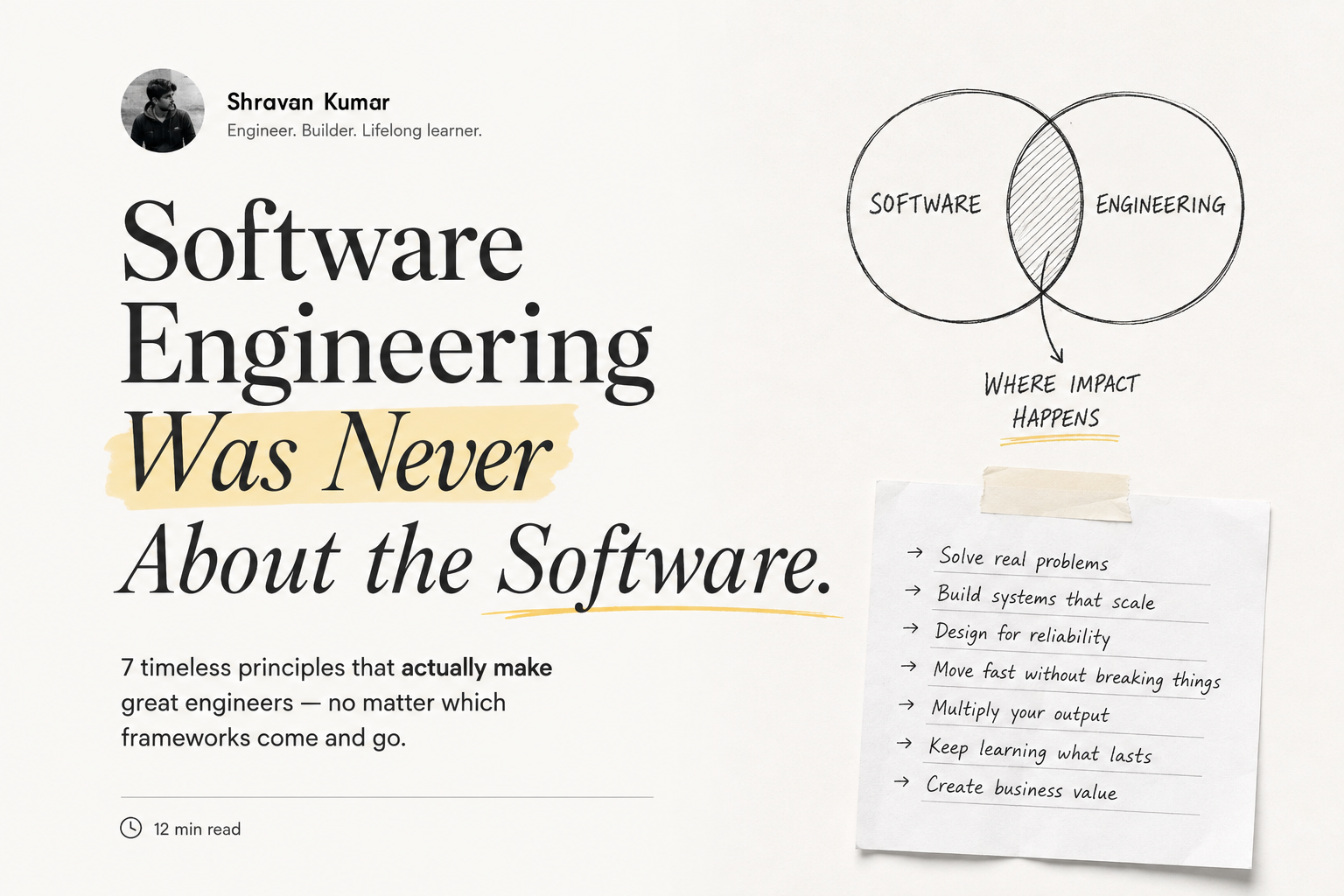 # Software Engineering Was Never About the Software
Every few weeks, your timeline splits into two camps. React vs. Vue. Go vs. Rust. Monolith vs. microservices. Someone finds a new tool, and now half your feed is asking if you're "still using" the old one.
I used to get pulled into this too. Then at some point it clicked none of this is actually what makes someone a good engineer.
Tech is going to keep moving. It always has, and it always will. The good news is you're not required to catch every train the moment it leaves the station you can hop on whenever you're ready and still get where you're going. But somewhere in this endless cycle of frameworks and "the right way to do things," I think we lost the actual point of the job.
We call ourselves software engineers. Somewhere along the way, everyone got obsessed with the "software" half and quietly forgot the "engineering" half.
This is my attempt to write down what I think actually matters. Not the syntax. Not the framework of the month. Not which language is "better." Just the stuff that'll still be true ten years from now, no matter what the timeline is arguing about today.
One disclaimer before we start: none of this is about memorizing DSA patterns or reciting syntax from memory. If that's what you thought this job was, this list is going to look different from what you expected.
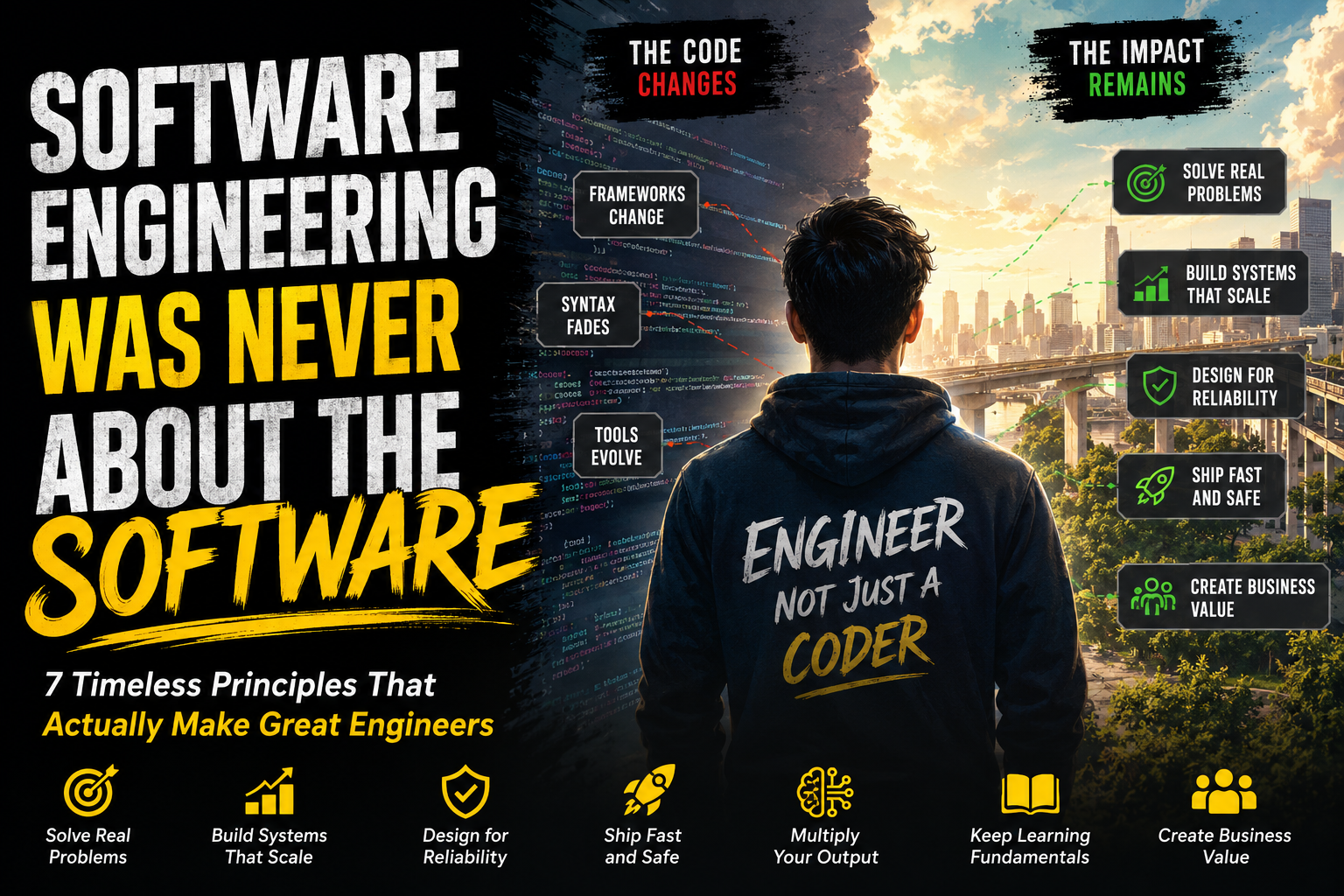
1. Solve real problems
Nobody pays for code. Nobody has ever emailed a client asking for "500 clean lines of TypeScript." They pay for outcomes a checkout flow that doesn't drop orders, a dashboard that saves someone two hours a day, a page that loads before the user gives up and leaves.
Code is just the medium you happen to be working in. The problem is the actual point.
If you can't explain what problem your code solves in plain language, to someone who isn't technical that's worth sitting with for a minute.
2. Build systems that scale
Writing a feature that works for one user on your laptop is easy. Writing one that survives ten thousand people hitting it at the same time is a different sport entirely.
Modern engineering is systems thinking. Before you ship anything, it's worth asking:
- Does this hold up at 100 users? At 10,000? At 10 million?
- What breaks first?
- Where's the actual bottleneck?
- How do I make this faster?
- How do I make this cheaper to run?
You don't need to architect for Google-scale traffic on day one. But you do need to know where your current design bends, and where it snaps.
3. Design for reliability
Good software works. Great software keeps working at 3 AM, during a traffic spike, when some third-party API you depend on quietly goes down for no reason at all.
That means thinking about the unglamorous stuff: retries, backups, monitoring, logging, disaster recovery, observability. Nobody gets excited writing a retry policy. But it's the difference between a five-minute blip nobody notices and a five-hour outage everyone remembers.
Here's a pattern worth noticing: senior engineers don't spend most of their time fixing things that broke. They spend it making sure things don't break in the first place. That's not an accident. That's the job.
4. Move fast without breaking things
"Move fast and break things" is a bad slogan the moment you have real users. The actual skill is shipping quickly and safely automated testing, CI/CD, feature flags, canary deployments, rollbacks you can actually trust, and monitoring that tells you something's wrong in minutes instead of days.
Shipping isn't a soft skill you pick up eventually. It's a core one. An engineer who ships safely and often is worth more than one who writes "perfect" code that takes six months to reach production because nobody benefits from code that hasn't shipped.
5. Multiply your output
AI changed the question everyone's being asked. It used to be "can you code?" Now it's "can you build ten times faster with the tools sitting right in front of you?"
Use AI for what it's actually good at: boilerplate, test generation, documentation, first-pass debugging, code review, research. That's not cutting corners it's using a power drill instead of insisting on a manual screwdriver because it feels more "real."
What AI still can't do is know what's worth building, or judge whether what it just handed you is actually correct, secure, and safe to ship. That judgment is your job now more than it's ever been. Your edge stopped being "I can type code." It's "I know what to build, and I can tell good output from confident-sounding garbage."
6. Keep learning the stuff that doesn't expire
Frameworks have a shelf life. Whatever you're an expert in right now probably won't be the hot thing in five years. Fundamentals don't have that problem.
Operating systems. Networking. Databases. Distributed systems. Cloud. Security. System design. These barely change, and everything else gets built on top of them. Learn whatever framework your job needs but treat the fundamentals as the actual curriculum, not the side quest.
I didn't come from a computer science background mechanical engineering, actually — and if that path taught me one thing, it's that the tool matters a lot less than understanding the system underneath it.
7. Create business value
Every technical decision is also a business decision, whether you're thinking about it that way or not. Before you write the code, it's worth asking:
- Does this reduce cost?
- Does this improve the customer's experience?
- Does this increase revenue?
- Is the complexity I'm about to add actually worth it?
The engineers who go furthest aren't the ones who know the most frameworks. They're the ones who can hold a technical conversation and a business conversation in the same breath, without needing a translator in between.
A different way to think about the job
Most engineers ask: how do I write better code?
Try asking instead:
- How do I build systems that don't fall over?
- How do I cut latency?
- How do I lower the cloud bill?
- How do I make the rest of my team faster?
- How do I make this easier for the next person to maintain?
- How do I get value into users' hands sooner?
Notice something none of these questions are really about code. They're about engineering. Code is just how the answer gets expressed.
How this shows up as you grow
Junior engineers write features, fix bugs, learn the tools put in front of them.
Mid-level engineers design components, own services, and start caring about performance instead of just correctness.
Senior engineers design systems, mentor the people around them, make the technical calls, and spend real energy preventing problems instead of just resolving them.
Staff and principal engineers shape architecture across teams, solve problems that don't belong to any single team, and influence how the whole org thinks about engineering.
Notice the pattern again. You don't move up this ladder by memorizing more syntax. You move up by understanding more of the system around you technical and human both.
The mindset that actually matters
The best engineers I've come across don't call themselves "Node developers" or "React developers." Ask them what they do, and they'll tell you something closer to: I solve problems. Software just happens to be my medium.
Languages change. Frameworks change. Even the AI tools we're all using right now will look completely different in five years. What doesn't change is the ability to reason about systems, weigh tradeoffs honestly, communicate clearly, and ship something that actually holds up.
If I had to compress this whole post into one line, it'd be this:
A software engineer exists to turn ideas into reliable, scalable, secure, and maintainable systems that create measurable value for users, and for the business.
That mindset is what separates engineers who stay valuable from the ones who don't, especially as AI keeps getting better at writing the code itself. The code was never really the hard part. Knowing what to build, why it matters, and how to make it hold up under pressure that's the actual job.
It always was.